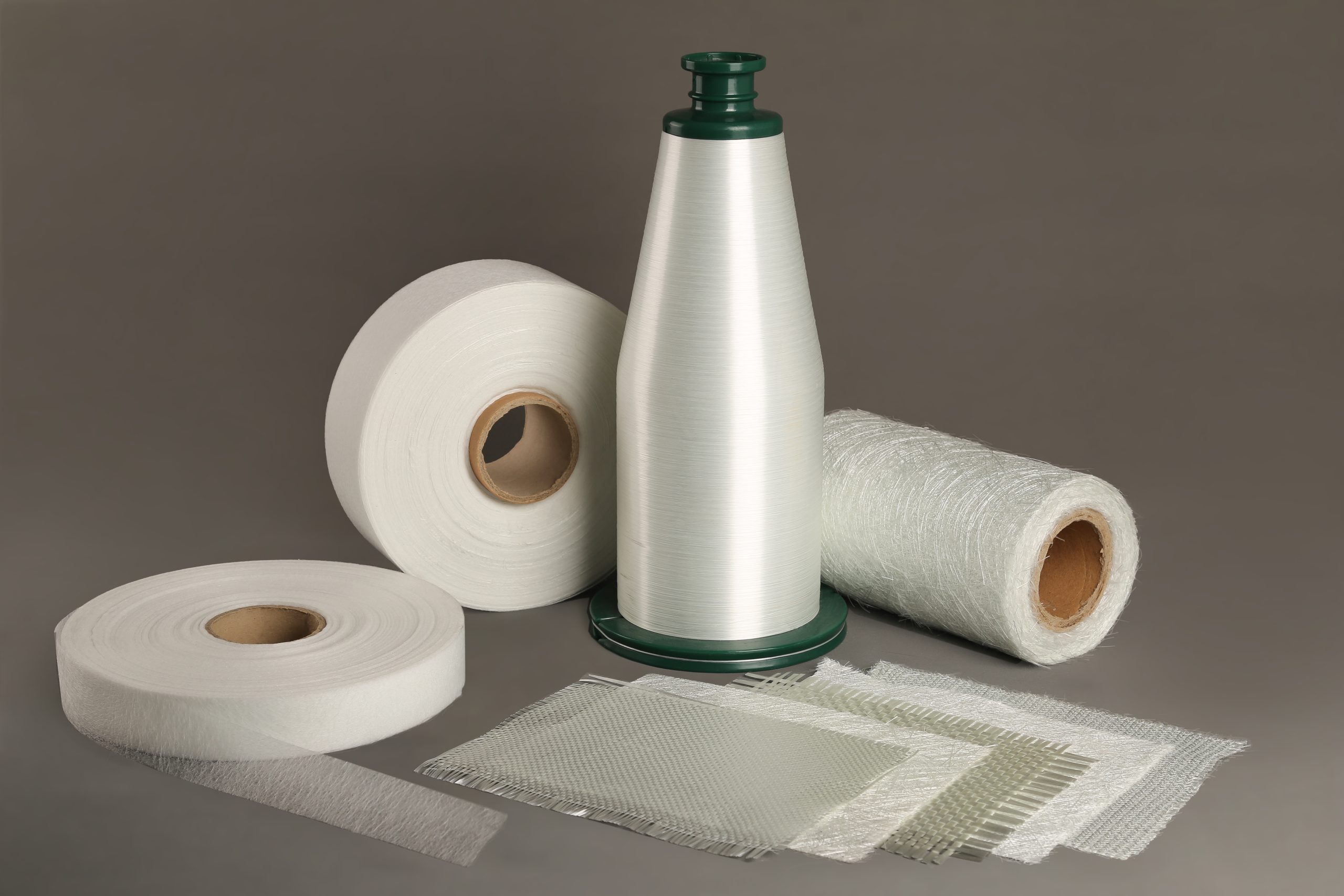
Woven Roving (Cam Dokuma)
Woven roving glass fiber is used for parts that require high tensile strength in two directions. It is suitable for producing components that demand high strength and works well with epoxy, polyester, and vinyl ester resins. Its features include high mechanical strength, dimensional stability, uniform texture, and high resin absorption capacity.
This product is used in the marine industry, boat manufacturing, containers, aircraft, automotive parts, interior decoration, sports equipment, corrosion-resistant tanks, wind turbines, and many other composite parts. It is generally preferred for composite parts requiring high mechanical strength on the surface and in multiple directions.
Sina Glass Fiber Company proudly produces woven roving in weights ranging from 200 to 800 grams and widths from 10 cm to 300 cm using the world’s most modern machinery and technology.
Stitch Mat (Cam Dikişli Keçe)
Stitch mat is made from chopped fibers. In this type, the fibers are arranged irregularly and sewn with polyester thread. Its standout features include excellent moldability, superior fiber coating, strong resin adhesion, and effective reinforcement of the part.
This product can be used with polyester, vinyl ester, and epoxy resins and is commonly applied in Hand Lay-Up, Pultrusion, and RTM processes.
Applications include shipbuilding, FRP boat hulls, automotive and vehicle bodies, laminates, chillers, and construction. Sina Glass Fiber Company is proud to manufacture stitch mats in various weights and widths using state-of-the-art machinery and technology.
Combo Mat (Cam Kombi Keçe)
Combo mat combines woven roving with a layer of chopped glass fibers sewn with zigzag polyester thread. The overlapping of two fiber types provides high strength, and the structure ensures excellent resin flow and adhesion. Its high dimensional stability increases production efficiency and application quality.
Combo mats are compatible with polyester, vinyl ester, phenolic, and epoxy resins. They are widely used in shipbuilding, automotive and vehicle bodies, laminates, chillers, and construction. Sina Glass Fiber Company produces this product in various weights and widths using the world’s most advanced machinery and technology.
Chopped Strand Mat (Cam Keçe)
Chopped strand mat is designed for hand lay-up continuous lamination, compression molding, various mechanical production processes, and other low-pressure methods. It is suitable for both single-layer and multi-layer molding techniques.
It is generally used in the composite industry for boats, tanks, silos, and panels, as well as large structural parts in transportation, construction, and other industrial applications.
Fiberglass chopped strand mat is high-performance and made from silane-coated E or ECR glass fibers.
The mat consists of 50 mm long fibers bonded with unsaturated polyester powder resin, offering excellent workability and molding properties. It has fast wetting and rapid resin absorption, allowing air bubbles to escape easily. Rapid wetting reduces resin consumption and produces a rich laminate surface.
This mat is compatible with all polyester resins (orthophthalic and isophthalic), vinyl ester, and epoxy resins. It is also resistant to moisture and corrosive chemicals. Sina Glass Fiber Company produces needle mats in various weights and widths using the latest machinery and technology.
Glass Tissue (Cam Tülü)
Glass tissue is the primary material for reinforcing the abrasion resistance of insulation coatings on metal pipes. Its most important features are high tensile strength, suitable flexibility, uniform paper thickness, resistance to decay, and compatibility for bitumen absorption.
Pipes insulated with this tissue—used for gas, oil, water, and other fluids—are fully protected against moisture penetration, reducing the impact of environmental factors that cause maintenance and repair costs.